Imperial College London
Motor-learning research using a real pool task in VR, with motion capture and EEG.
At Imperial, I studied neural computation, machine learning, brain-computer interfaces, statistics, and motor control. I joined the Brain & Behaviour Lab as an associate researcher during the degree.
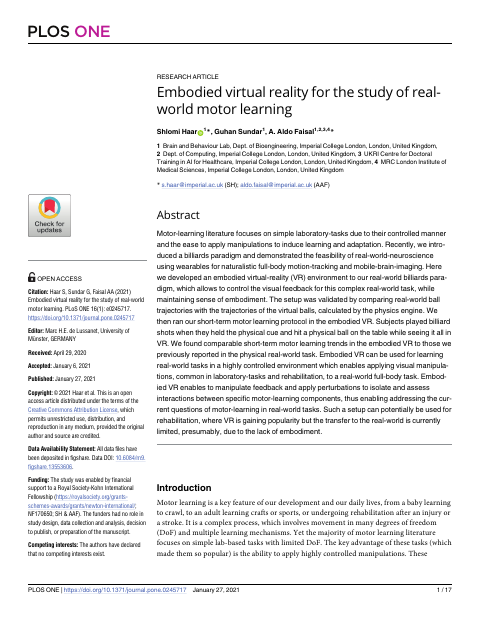
My dissertation involved an embodied VR platform for studying motor learning. Participants used a real pool cue and ball while viewing the task in VR, with motion capture and EEG recorded alongside. I was second author on the resulting PLOS ONE paper, published in 2021.
I moved to London for the degree and played for Imperial’s first team. The combination of research and soccer gave me two ways to think about how people learn a physical skill.
After the MSc, I joined Kernel to work on the instruments used to collect brain data.
Threads
Assets
paper
Paper, PLOS ONE 2021 — Embodied virtual reality for the study of real-world motor learning
2021-01-27
Haar S, Sundar G, Faisal AA (2021) Embodied virtual reality for the study of real-world motor learning. PLoS ONE 16(1): e0245717.
video
Embodied VR billiards — supplemental video
2020