Guhan Sundar

EEG · MEG · WEARABLES · DATA INFRA — 2012 → NOW

ERP biomarker program

research · 2021-08 → 2026-07 · 4y 11m

Event-related potential biomarkers from experimental design through analysis; one used as a Phase 2 primary pharmacodynamic endpoint.

Alto Neuroscience

What

Alto’s event-related-potential biomarker program. EEG is recorded while a participant performs an auditory or cognitive task, yielding features — mismatch negativity, N1, theta inter-trial coherence — that index specific circuit functions and can move measurably under a drug.

What existed before the program was partially assembled and produced no usable signal; the components were not correctly connected. Building it from there meant the psychophysics task and its EEG integration; the timing and latency work with engineers — delay testing, benchtop testing, debugging; the literature review that chose which tasks and which ERP components to use; and the entire analysis pipeline: preprocessing, ERP extraction, artifact removal, SNR characterisation, QC across tasks and components, and case-control validation. Nothing was assumed from published literature — every step was validated empirically on data from the system as built. The program carried through phase 0, into a phase 1 refinement stage in healthy participants, and then into phase 2a.

Why it mattered

A biomarker is only useful in a trial if non-specialist staff at many clinical sites can acquire it reliably and it still comes out clean enough to detect a drug effect. Timing is the whole game: an ERP is defined by its latency, so a few milliseconds of unmeasured jitter between stimulus and trigger destroys the measurement before any analysis begins. Most of the work was closing the distance between a noisy scalp trace and a number a drug-development team can act on.

My role

Built the program from scratch — experimental design, acquisition, and analysis — and served as the technical point of contact between the clinical, engineering, and drug-development teams. Partnered with the technical solutions team on the acquisition pipelines, QC dashboards, and debugging tools used to onboard sites and triage data quality during live collection.

Outcome

Built Alto’s EEG/ERP biomarker program from zero signal to a biomarker used as the primary pharmacodynamic endpoint in a Phase 2 schizophrenia trial.

The capability and the molecule are separate results. That trial’s topline, reported in April 2026, was that ALTO-101 “did not achieve statistical significance on primary electroencephalography (EEG) or cognitive endpoints versus placebo,” while showing directional improvements across certain EEG measures, including a near-significant effect on theta inter-trial coherence (n=83, d=0.34, p=0.052). An endpoint good enough to run a trial on outlives whichever compound it was first pointed at.

Named inventor on US 2025/0120957 A1 — Treatment of neuropsychiatric disorders with tilivapram. First author on the SOBP 2025 poster on translational ERP and time-frequency features in cognitive impairment associated with schizophrenia, and first author at ACNP 2026.

Assets

  • patent

    Patent US 2025/0120957 A1 — Treatment of neuropsychiatric disorders with tilivapram

    2025-04-17
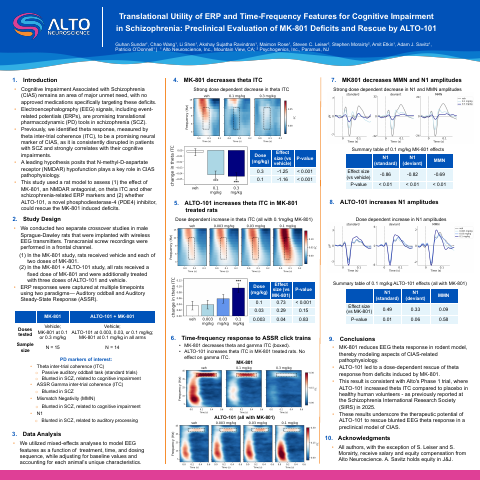
  • Poster, SOBP 2025 — Translational utility of ERP and time-frequency features for CIAS: preclinical evaluation of MK-801 deficits and rescue by ALTO-101

    poster

    Poster, SOBP 2025 — Translational utility of ERP and time-frequency features for CIAS: preclinical evaluation of MK-801 deficits and rescue by ALTO-101

    2025-04