Biomarker discovery & validation
Signal processing, statistics, and machine learning applied to EEG and other clinical data for biomarker research.
What
Analysis of EEG, ERP, wearable, speech, and cognitive data from Alto’s clinical studies and earlier datasets. The research examined how physiological measurements related to clinical outcomes.
Why it mattered
The team wanted to evaluate whether measurements collected before treatment could help identify differences in response. That required testing candidate features across datasets and studying their relationship to drug mechanisms.
My role
Built resting-state EEG preprocessing and feature pipelines, developed Python packages, and worked on patient-stratification models and marker validation. First author on the SOBP 2025 dopamine-depletion poster.
Outcome
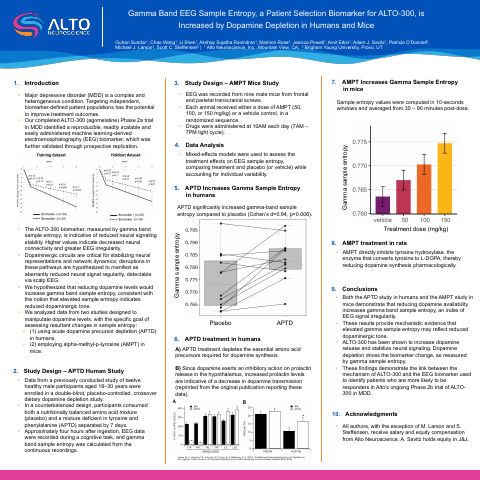
EEG biomarkers from this work were used in Phase 2 trials. The poster reports the relationship between dopamine depletion and gamma-band sample entropy, a feature used in patient-selection research.
Assets
poster
Poster, SOBP 2025 — Gamma band EEG sample entropy, a patient selection biomarker for ALTO-300, is increased by dopamine depletion in humans and mice
2025-04